
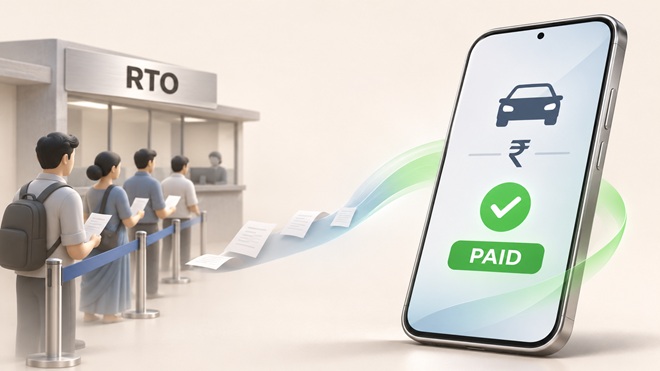
Settling a traffic fine once meant a trip to a transport office, a long wait in a queue, and a counter transaction that could consume the better part of a working day. That experience is fast becoming a thing of the past. Online access has moved the handling of penalties off the premises and onto a screen, changing one of the more tedious chores of vehicle ownership.
The move online is part of a broader digitisation of citizen services, and traffic penalties have proved especially well suited to it, because the whole process can be completed remotely.
The old way of queues and counters
In the traditional model, resolving a fine required being physically present. A motorist would travel to the relevant office, wait their turn, and complete the matter in person, often losing the better part of a day in the process.
The friction was considerable, and it discouraged prompt resolution, since settling even a small fine demanded a disproportionate amount of time and effort.
The online alternative
Online access removes almost all of that friction. A penalty can now be looked up and cleared from a phone or computer, using only the vehicle’s registration number, at any hour and from anywhere.
What once took a half-day visit now takes a few minutes, and the counter trip has become unnecessary for the great majority of cases.
Traffic penalties were almost tailor-made for the move online. Unlike services that require a physical inspection or a signature in person, settling a fine is essentially a lookup and a payment, both of which translate naturally to a screen. There was little about the task that genuinely required a counter.
Once the online route existed, the advantages were so obvious that motorists adopted it with little persuasion. The convenience did the convincing on its own.
What moving online changes
The shift does more than save time. It creates a clear digital record of what was paid and when, it lets motorists act the moment they become aware of a fine, and it removes the uncertainty of wondering whether a visit will resolve the matter in one trip.
Convenience and record-keeping arrive together, which is why the online route has been adopted so readily.
The improvement runs across the whole process. Finding out whether a penalty exists, confirming its details, settling it, and keeping proof of payment can now all happen in a single sitting, without travel or waiting.
That end-to-end simplicity is a marked contrast to the old sequence of travelling, queuing, and hoping the matter could be closed in one visit. The online route compresses all of it into a few minutes.
A pattern seen across states
The same transition is unfolding across the country. In Telangana, for instance, a ts e challan can be looked up and settled online, mirroring the move away from counters seen elsewhere. The details vary from state to state, but the direction is consistent.
Wherever it has been adopted, the online channel has quickly become the default way to deal with a penalty.
Another gain of the online model is portability. Because the record lives in a system rather than in a single office’s files, a motorist can deal with a penalty from anywhere, even far from where it was issued.
This is particularly useful for those who travel between cities or states, where a fine incurred in one place once meant a return trip to settle it. Online access removes that geographic tie almost entirely.
The result is a system that fits the way people actually move, rather than one that assumes they will always be near the office that issued the penalty.
Convenience with accountability
Moving online has not come at the cost of rigour. If anything, the digital record is more reliable than the paper trail it replaced, since every lookup and payment is logged and can be reviewed later.
Motorists gain convenience, and the system gains a cleaner, more auditable record, which serves both sides well.
For the ordinary motorist who picks up a fine now and then, the change is especially welcome. A single minor penalty never justified the time cost of an office visit, and many were left unresolved simply because settling them was more trouble than it was worth.
Online access removes that imbalance. A small fine can be cleared the moment it is noticed, so penalties no longer linger merely because dealing with them used to be inconvenient.
The counter becomes the exception
The direction of travel is clear. As more states bring their penalties online and motorists grow used to settling them in minutes, the online route is on course to become not just the common choice but the expected one.
What began as a convenient alternative is steadily becoming the standard way the country handles its traffic fines.
As online handling becomes the norm, the office visit is turning into the exception reserved for unusual cases rather than the default path. For most motorists, a penalty is now something to be resolved in a few taps rather than a trip across town.
That reversal, from counter-first to online-first, captures how thoroughly the everyday experience of dealing with traffic fines has changed.
